
作者:Yu-Hsuan Chang, Cheng-Hao Chang, Shih-Ta Liu, Su-Chu Hsu
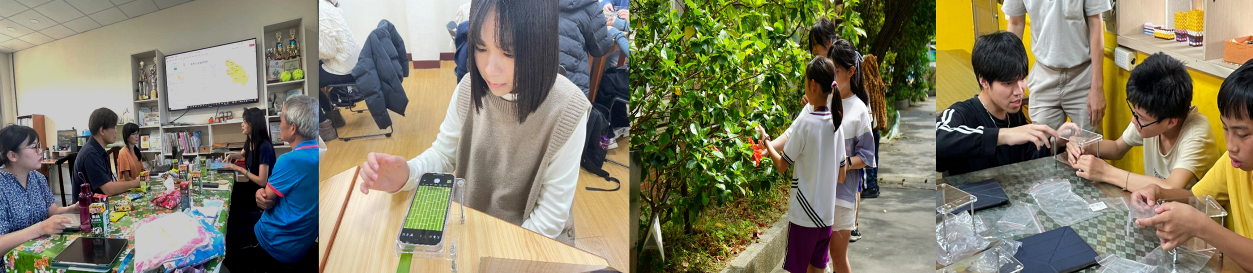
摘要:To fulfill the USR goals prioritized by Taiwanese universities, we adopted the global Design for Change (DFC) model by Kiran Bir Sethi to develop the Place Change Maker (PCM) strategy, integrating place exploration, design thinking and making, and place-based change practices. Using PCM, we carried out social service projects at four rural primary schools — each with over 80 years of history and fewer than 50 students, at risk of closure. Through digital fabrication, we developed an upgraded “digital microscope” and led the Micro Project — Small Plants, Big Discovery workshops, in which students built and customized their own microscopes to explore the microscopic ecology of characteristic campus plants. We provided “M2M ChatGPT” procedures to investigate the connection between microscopic plant features and real-world landscapes — for example, observing that bamboo leaf nodal structures resembled aerial photos of car factories, or that pennywort leaves resembled the Place Charles in Paris from above. This exploration enhanced students’ digital literacy, broadened their global perspective, and supported the Sustainable Development Goals of “Quality Education” and “Reduced Inequalities.”
關鍵字:Digital Fabrication, USR, Design for Change, Rural Education, AI Image Recognition, Digital Microscope, Place-Based Learning